
Gold has fascinated humanity for thousands of years. From ancient civilizations to modern economies, this precious metal has symbolized wealth, power, and beauty. But gold’s true value lies not only in its shine—it lies in its extraordinary origin and natural rarity.
The Cosmic Birth of Gold
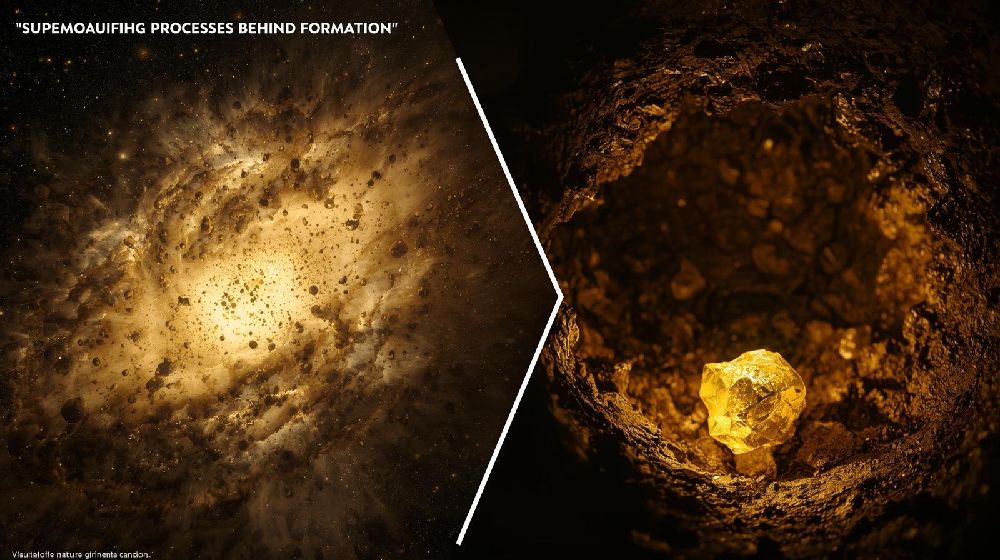
Gold is not formed on Earth in the traditional sense. Scientists believe that gold originated in outer space, created during powerful cosmic events such as supernova explosions and neutron star collisions. These cataclysmic events generate extreme heat and pressure, allowing heavy elements like gold to form at the atomic level.
When Earth was forming billions of years ago, these gold-rich particles became part of the planet’s structure. Over time, geological processes brought small amounts of gold closer to the Earth’s crust.
How Gold Reaches the Earth’s Surface
Although gold exists deep within the Earth, it becomes accessible through natural geological processes:
-
Volcanic activity pushes gold-bearing magma toward the surface.
-
Hydrothermal fluids carry dissolved gold through cracks in rocks, where it eventually solidifies.
-
Erosion and weathering break down rocks, releasing gold particles into rivers and sediments.
This is why gold is often found in veins within rocks or as placer deposits in riverbeds.
Why Gold Is So Rare
Gold’s rarity is a result of several factors:
-
Limited Natural Formation: Gold can only be created during rare cosmic events, making its overall supply extremely finite.
-
Deep Earth Storage: Most of the Earth’s gold sank into the core during the planet’s formation, leaving only a small fraction accessible near the surface.
-
Low Concentration: Even in gold-rich areas, the metal appears in tiny amounts. Tons of rock must be mined to extract a small quantity of gold.
-
Non-Renewable Resource: Unlike biological resources, gold cannot be regenerated once extracted.
Why Gold Remains Valuable
Gold’s rarity is enhanced by its unique properties. It does not corrode, tarnish, or rust, making it one of the most durable metals on Earth. Its malleability allows it to be shaped into intricate designs, while its conductivity makes it valuable in technology and electronics.
Conclusion
Gold’s journey—from cosmic explosions to deep within the Earth, and finally into human hands—is nothing short of extraordinary. Its natural formation, limited availability, and unmatched physical properties make it one of the rarest and most treasured elements on the planet. This rarity is precisely why gold continues to hold immense value in jewelry, investment, and culture across the world.