
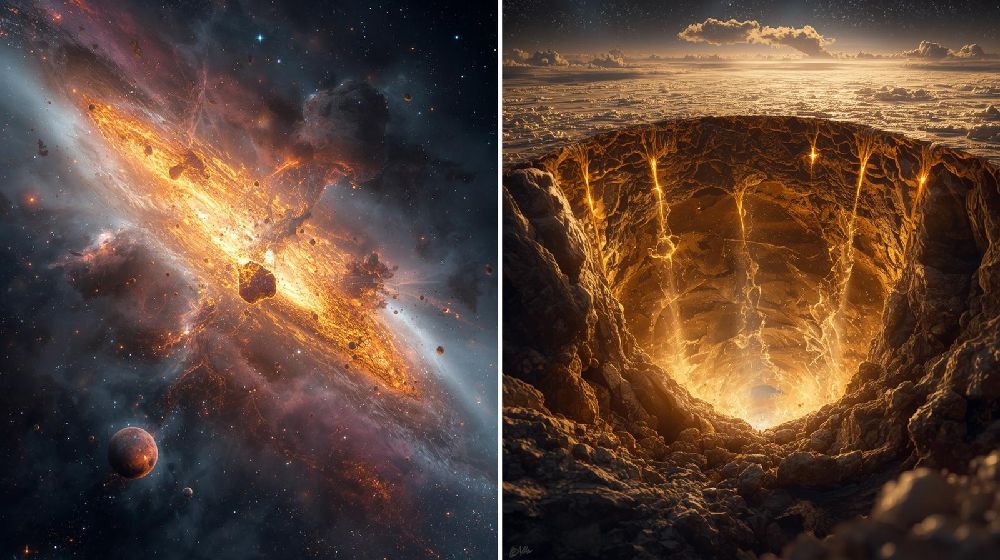
Gold has fascinated humanity for thousands of years—not just for its beauty, but for its rarity and permanence. Unlike many materials used in fashion and industry, gold cannot be artificially created in nature-like abundance. Its journey begins far beyond Earth and continues deep within our planet, making it one of the most precious elements known to us.
Gold’s Cosmic Origin
Gold is not formed in the Earth’s crust like most metals. Scientists believe that gold was created billions of years ago during violent cosmic events, such as the collision of neutron stars or supernova explosions. These extreme conditions provided the immense energy required to form heavy elements like gold.
When Earth was formed, gold particles became embedded within the planet, mostly sinking toward the core due to their weight. Only a small fraction remained accessible in the Earth’s crust, which is why mineable gold is so limited.
How Gold Reaches the Earth’s Surface
The gold we mine today reached the surface through geological processes over millions of years:
-
Volcanic activity pushed gold-bearing material upward
-
Hydrothermal fluids carried dissolved gold through cracks in rocks
-
Erosion and river movement concentrated gold into placer deposits
These slow, natural processes explain why gold is found in specific regions and not evenly distributed around the world.
Why Gold Is So Rare
Gold’s rarity comes from several factors:
-
Limited natural formation: No new gold is being created on Earth
-
Deep planetary storage: Most gold remains locked in the Earth’s core
-
Low concentration: Even rich gold ore contains only tiny amounts of gold
-
Difficult extraction: Mining and refining gold require advanced technology and significant resources
All the gold ever mined in human history could fit into a cube roughly 22 meters on each side—an astonishing fact that highlights its scarcity.
Why Rarity Makes Gold Valuable
Gold’s rarity directly contributes to its value. Unlike fashion materials or industrial metals that can be mass-produced, gold remains finite. It does not corrode, degrade, or lose its elemental integrity, making it a reliable store of value across civilizations and centuries.
This natural scarcity, combined with durability and universal appeal, is why gold continues to symbolize wealth, trust, and timeless luxury.
Gold in Jewelry: Nature’s Rarity Worn
When gold is shaped into jewelry, it carries millions of years of natural history. Every ring, bangle, or chain is not just an accessory—it is a piece of the universe refined by human craftsmanship. This deep origin adds emotional and symbolic value to gold jewelry, making it more than just a precious metal.
Conclusion
Gold’s formation is a story written in stars and shaped by Earth over billions of years. Its rarity is not artificial or market-driven—it is a natural truth. This is why gold remains unmatched in value, symbolism, and desirability. From cosmic beginnings to modern jewelry, gold’s journey is a powerful reminder that true luxury is born from time, nature, and rarity.